September 27, 2022

Poosanikaai Puli Kootu - Kalyana Kootu


Share with friends and family 3 comments:

 Puli Kootu or Pulippu Kootu is an authentic Tamil brahmin recipe and is made quite frequently in most homes .It is a must have on the wedding feast menu and hence also known as Kalyana Kootu . 

Puli kootu is very tasty as it has a balance of all flavors and the tanginess from the tamarind extract gives it an altogether different flavor profile.

Pulippu kootu fits perfectly for those following a Vegan Diet and also being a No onion No garlic recipe  it is Saatvik and Jain Friendly as well.
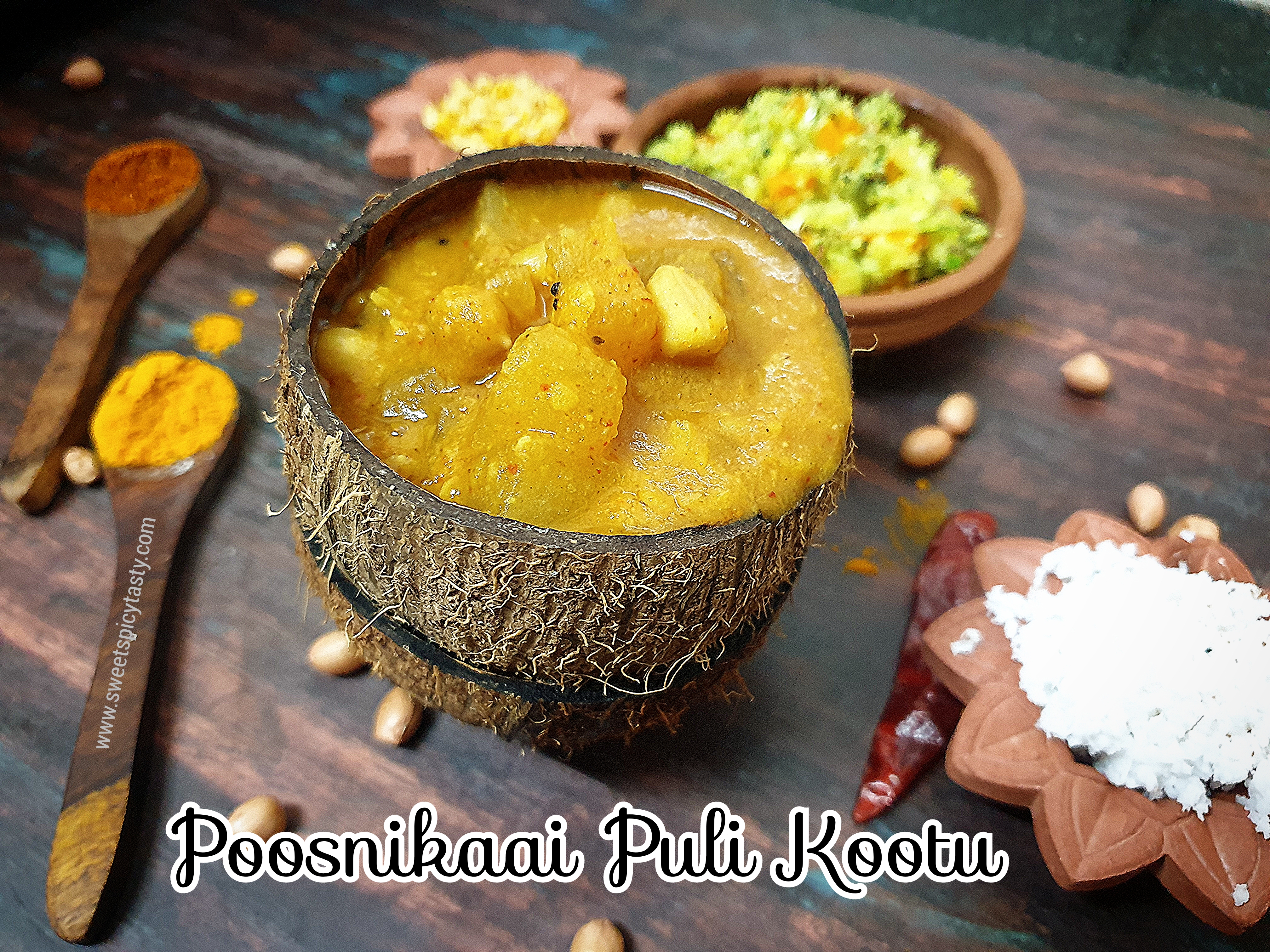
Pulippu kootu can be made with brinjals,  ash gourd /white pumpkin or chayote/chou chou . In traditional tambrahm weddings puli kootu is made from ash gourd/poosanikaai and has either boiled chick peas or groundnuts added to the kootu .

In my recipe today ,I am going to use boiled peanuts but I also make it using boiled chickpeas many a times and both of them taste really delicious. 

Puli kootu with hot rice and some coconut based vegetable stir fry is an amazing combination for lunch.  In my home most often the left over puli kootu is paired with chapati for night and it pairs well .


Preparation Time - 15 mins
Cooking Time - 30 mins
Complexity- simple 
Serves - 2 to 3

Ingredients 

2 cups chopped ash gourd /poosanikaai 
1/4 cup thoor dal /pigeon peas/thuvaram paruppu
1/4 cup peanuts 
Small lemon sized tamarind ball
Few curry leaves 
Pinch of turmeric
Salt as needed 
2 tsp oil 
1/2 tsp mustard seeds
Pinch of asafoetida 

To roast and grind
1 tbsp channa dal 
1 tbsp dhaniya/corriander seeds
2 tbsp coconut grated 
3 to 4 dry red chillies 

Method


  • In a pan heat 1/4 tsp oil and roast the channa dhall until crisp and golden brown followed by the dhaniya and red chillies.Allow it to cool and the  grind into a fine paste with coconut and set aside. 
  • Soak the tamarind in hot water for 10  mins and then extract the pulp . Strain the impurities and keep ready .
  • Boil the chopped ash gourd in sufficient water until it is cooked well..it has to be firm but well cooked .
  • Pressure cook the thoor dhall and peanuts in 2 separate containers in the same cooker .Mash the thoor dhall well and set aside.  This saves a lot of time and effort as well.
  • In a thick bottomed vessel,add the boiled ashgoured ,peanuts and the tamarind extract with 1/4 cup water and boil it until the raw smell of the tamarind is lost. 
  • Next add the coconut paste , cooked thoor dhall and another 1/2 cup water and bring to a rolling boil.Adjust salt at this stage . Donot boil too much as the dhall will begin to start sticking to the bottom of the pan and it may get burnt..we don't want a burnt kootu .
  • Prepare a tempering of mustard seeds, curry leaves and asafoetida and pour it on the pulippu kootu.

Pin it up for future 


September 25, 2022

Little Millet Poha - Samai Poha (Vegan breakfast)


Share with friends and family 7 comments:

 Millets are a very good alternative to rice due to their low glycemic index (GI) value which helps in control of insulin and absorption of carbohydrates into the blood stream making it ideal for people with Diabetes.  

Millets also help in weight loss as they are rich in proteins and fibre.

There are lot of millets available like Jowar, Bajra, Ragi ,Little millet, Kodo millet , Barnyard Millet etc . You can very conveniently replace the usage of rice with millet and work towards a healthy lifestyle. 

I am slowly trying to transition into using millets in my daily diet and I am certainly seeing a lot of difference.  Sudden hunger pangs,  mid morning cravings have reduced a lot and millets keep me full for a long time. 

Little Millet is known as Samo Chawal/Kutki  (Hindi), Samai Arisi (Tamil),  Saame (Kannada) , Samaalu (Telugu) .

Little millet is very rich in Magnesium,  Vit B components and also in phosphorous and zinc which help in building energy in the body. 

Making little millet poha is very easy, almost same as making the Poha using Flattened rice.  You can flavor and season it with the spices of your choice.  

Little millet flakes are available in most leading super markets and shops .Also there are many exclusive outlets selling millet based products from where we can procure them easily . 


Preparation Time - 10 mins
Cooking Time - 10 mins
Complexity - easy
Serves - 2 to 3

Ingredients 

1.5 cups little millet poha /flakes 
2 tbsp oil
Handful of peanuts 
Handful of frozen peas (thawed )
1tsp cumin /jeera
2 green chillies chopped 
Few curry leaves 
Salt as needed 
2 tsp lemon  juice
Pinch of turmeric 

Method 


  • Wash the little millet flakes under running water and let it rest in a colander for 10 15 mins . The millet flakes absorb the water and turn soft. 
  • Heat the oil in a kadai, fry the peanuts followed by cumin ,green chillies, curry leaves.
  • Throw in some salt and turmeric followed by the soaked little millet flakes and also the green peas .
  • Toss it well ,cover and cook for 3 to 4 mins . Lastly mix the lemon juice and garnish with fresh corriander and serve hot.

Pin it up


September 22, 2022

Navaratri Special - Significance & Prasadams


Share with friends and family 7 comments:

 Navaratri is just round the corner and it is a very special festival for Hindus.  The whole of India celebrates Navratri in different ways and it is the most awaited festival for the ladies.

Navaratri is a festival that  celebrates the victory of good over evil by Goddess Durga . The festival is spread across 9 nights and 10 days hence the name Nav Ratri (Nav is 9 and Ratri is night) .

The last day is celebrated as Dussehra or Dassera, a  day that is considered very auspicious to start anything new . 

As I already said each region in India celebrates Navaratri in different ways and the ladies thoroughly enjoy this festival .

Read the full blog to know how various regions celebrate Navratri across our country.

In Northern India , each day is dedicated to 9 forms of Maa Durga  ; Shailaputri  ,Brahmacharini ,Chandraghanta ,Kushmanda ,Skandamaata , Katyayani  ,Kaalaratri, Mahagauri,Siddhadhatri. 

Devi is worshipped  by chanting Chandi Paath/ Havan ,devi Mahatmyam etc. Most ladies fast for the 9 days and break their fast on Navami .

The Ashtami Day is  celebrated as Kanya Puja where young girls who haven't attained Puberty are called home and worshipped as an Incarnation of lord Durga ma and offered with Prasadam and small gifts like Bindi , chunri , mehendi etc. Prasad on Ashtami is Poori ,Halwa and Kala Channa .

In Gujarat , a decorated earthen pot called Garba is placed with a lamp lit inside which is kept as Akhand Diya for all 9 days ..this Garba is symbolic of the womb and the word is derived from the Sanskrit word "Garbh". There is a  belief that just as the mother protects the baby in the womb, Ambe Maa is the protector of the world and she protects us from the wordly  wrath. 

Bengal and Eastern India is known for its Durga Puja Utsav during Navratri and the massive pandals that are set up all over the city which have huge and beautiful idols of Durga Maa sculpted to perfection and on the day of Dassera after the Pooja ,the idols are immersed in water bodies .


In Tamil Nadu and Karnataka ladies set up Golu ,which is a display of dolls of various Gods and Goddesses and also other mythological characters.  Social themes are also displayed and lot of contests are conducted to applaud and recognize the hard work .  The 9 nights of Navratri are dedicated for Durga ,Lakshmi and Saraswati . The 9th Day is celebrated as Saraswati Pooja / Ayudha Pooja in Tamil Nadu ..to know more about how it is celebrated, read my post on Saraswati Pooja Special.

What is Golu / Bomma Kolu / Bombe Habba ?

GOLU is a display of Dolls arranged on steps like structure which are odd in number like 1 , 3, 5 , 7 , 9 steps etc .

Traditionally beautifully colored clay dolls of various Gods and Goddess & Mythological story related dolls would be on the display and these dolls are handed down from generations.  Carefully packed and stored for use year on year. 

 Slowly, with social awareness and creativity,  dolls with social themes also got added to the collection and people who display golu started presenting various themes to bring related to current affairs and social responsibilities. 


Each day a special prasadam is offered to Devi after pooja in the morning and evening. 
Normally in the morning, we offer some kind of sweet as prasadam and in the evening we offer sundal prasadam. Navaratri and Sundal go hand in hand .

Sundal is a simple stir fry using various beans and legumes . A very good source of protein and energy. 


This sundal prasadam is distributed along with the Haldi Kumkum Thamboolam which is given to all the ladies who visit the house for Golu . 

What is thamboolam ?

Thamboolam is an offering of betel leaves, betel nuts, coconut a fruit and haldi kumkum .

Refer to the collection of recipes below which I am linking for your easy reference 


Verkadalai Sundal / Peanut Sundal

Kondakadalai Sundal/Chickpeas Sundal

Karamani Sundal / Lobia Sundal

Karuppu Kondakadalai Sundal / Brown Chickpeas sundal

Thengai Mangai Pattani Sundal / Dried peas sundal

Rajma Sundal 

Kadalai Paruppu Sundal / Gram Dhal Sundal

Kadhamba Sundal / Mixed Sundal

Pacha payaru Sundal / Green Gram Sundal

Sundal using Sundal Podi

Traditional sweets offered as prasadam for Navaratri 


Seeyam / Sugiyan (Saraswati Pooja Spl )


September 12, 2022

Namkeen Moong Dal | Fried Moong (split green gram)- Vegan snack


Share with friends and family 9 comments:

 Namkeen moong dal is a very tasty and addictive tea time snack which is enjoyed by all age groups .

A popular snack which is sold by major snack brands, in India and abroad this certainly is a Go to snack which most of us will stock at home to just munch on for time pass .

You can also make amazing chaat with this fried moong dal by adding chopped onions ,tomatoes, fresh corriander and dress with some fresh lime juice .


To make namkeen moong dal at home ,you need to have a few pre preparations, but if you plan your work accordingly, this tasty snack can be made just in time for your tea time or the time when kids are back from school.

The key to get perfectly fried moong dal is to pat dry the soaked moong dhal on a cotton cloth until it is totally dry and moisture free . A small amount of moisture also will end in oil splutter while frying which is definitely risky and hazardous.  So take care to dry up the moong dhall before frying.

The fried moong dal is seasoned with basic spices like salt and chat masala ,but you can also add some red chilli powder if you may like. I prefer to keep it plain salted with a hint of chaat masala . 


Preparation Time - 4 hrs
Frying time - 15 mins
Complexity - easy
Serves  - 3 to 4 

Ingredients 

2 cups of moong dal / yello split gram
Oil to fry
Salt as needed 
Pinch of chat masala 

Method 

  • Wash and soak the moong dal in a bowl of water for 3 to 4 hrs .
  • Drain the water through a colander and spread the soaked moong dal on a soft cotton cloth for about 30 mins under shade so that all the moisture is absorbed by the cloth .
  • Heat up the oil and fry the moong dal in small batches until it turns crisp and appears golden yellow. Fry in medium flame and be vigilant else it will  burn too quickly .
  • To the fried moong dal add salt and chat masala and mix it well .Store it in an air tight container.  Use a dry spoon to use while serving. 
  • Enjoy this addictive snack with your tea or a leisure drink with your friends and family.


September 08, 2022

Chakka Pradhaman using Chakkavaratti - Sadhya Special


Share with friends and family 4 comments:

 Onam is the harvest festival of Kerala and also the day to comomerate and celebrate Vamana and King Mahabali .Whole of Kerala and Malayalees world over celebrate the day with a lot of joy and happiness. Onam is a ten day festival and as per gregorian Calender falls anyday between August - September which coincides with the  Chingam Month as per Malayalam Alamanac on the star of Thiruvonam or Sravanam which is the 22nd star or Nakshatra.


Mahabali was a very generous and powerful king who ruled Kerala and there was abundant prosperity and happiness during his reign. It is believed that on this day King Mahabali or Maaveli visits the land of Kerala and rejoices with the people of the land . To welcome the King ,an elaborate rangoli or kolam using flowers is decorated at every home , a lavish spread known as Sadhya is prepared and the annual boat race is held by the State .

ONAM is the annual state festival of Kerala.

I have already posted almost all recipes prepared for a Sadhya on my blog .I will post the link below which can be used as a ready recokner. 

Today we shall see a very traditional and authentic sweet chakka Pradhaman made using Jackfruit Jam known as Chakka Varatti . I have already posted how to make chakka varatti during jackfruit season .

This paysam is really easy to make if we have the chakka varatti ready on hand . The other  version to make Chakka Pradhaman from scratch can be found here. 

Without further delay,let me get to the recipe quickly .


Preparation Time - 10 mins
Cooking Time - 15 mins
Complexity - simple
Serves - 2 to 3

Ingredients 

1/2 cup chakka varatti / jackfruit jam
3/4 cup grated coconut 
3 tbsp jaggery 
1/2 cup thick coconut milk 
2 tbsp finely chopped coconut bits 
2 tsp ghee 

Method


  • Blend the chakka varatti, grated coconut and jaggery with 1/4 cup water to a very fine paste .
  • In a heavy pan ,heat the ghee and fry the coconut bits until they turn crisp and brown.
  • Pour the blended paste to this fried coconut and bring it to a quick boil .
  • Add the thick coconut milk in the end ,mix well and turn off the stove .Donot try to over cook or boil the Pradhaman after adding the coconut milk ..the Pradhaman will curdle .the heat is enough to cook the coconut milk and take away the raw smell.
  • Delicious chakka Pradhaman is ready. 

Pin it up 


Sadhya recipes on the blog. Click on the individual items below to get detailed recipe


August 16, 2022

Vella Seedai /Innipu Cheedai - Janmashtami Special


Share with friends and family 11 comments:

 Vella Seedai or sweet jaggery fritter balls are an essential prasad /offering made for Gokulashtami/ Krishna jayanthi to celebrate the birth of Lord Krishna .

We make two types of seedai; Uppu seedai (savory)  and Vella seedai (sweet) along with various other favorites of Lord Krishna to be offered on the special day when we all rejoice and celebrate lord Krishna's birth .

To know how we celebrate Krishna Jayanthy in a typical Tambrahm (Tamil Brahmin) house hold head over to my post, Krishna Jayanthy Celebrations where you can also find link to all the special recipes we make for the big festival .


Making seedai is an art and requires a little expertise and caution while making it . With practice we can easily master this and become a pro .

I am giving all tips and tricks to make a fail proof seedai so that even beginners and newbies can make it with an ease . These tips are applicable for flours which are either home made or store bought. 

Traditionally rice flour and udad dhall flour at prepared at home for purpose of maintaining hygiene and quality but now a days we get good quality ready made flours so we can use that even. 

In this recipe, I have used store brought rice flour and  udad dhall flour to make the recipe, thus making it easy for working women and those who are pressed for time.   

Points to keep in mind 

  • Roast the rice flour in a dry pan until it feels warm. The flour should be roasted just until you can feel the warmth no need for the flour to change color . Sieve the flour well through a sieve once it cools down.
  • Roast the udad dhall flour the same way and sieve it. If you are unable to find ready made udad dhall flour,  take 1 cup of udad dhall and dry roast in a pan until it turn crisp ,cool it and then blend into a fine powder using the blender . Sieve it to get a really fine powder without any grits . 
  • Melt the jaggery in hot water and strain it to remove any impurities .
  • Sieving the flours and jaggery syrup is very important as even a small particle or grit can cause the seedais to burst in the oil .

To know how to make Uppu Seedai and also on how to roast the flours check the video link below 


Ingredients 

1 cup rice flour 
1tbsp udad dhall flour /Ulutham maav
1/2  cup grated jaggery + 3/4 cup water to melt it
1/2 tsp white sesame seeds / yellu 
2 tsp grated coconut  (optional)
Pinch of cardamom powder
Oil to deep fry 
1 tbsp unsalted butter/ ghee at room temperature 

Method

  • Take a wide mixing bowl and add the sieved rice flour and udad dhall flour along with the sesame seeds and grated coconut. 
  • Meanwhile, heat the melted jaggery in a pan and let it come to a rolling bowl.we donot need ant string consistency.  When the jaggery is boiling add in the cardamom powder to this.
  • Pour this hot jaggery syrup over the flours and mix it gently with a spoon so that the syrup gets incorporated well with the flours.
  • Now add the melted butter and gently with your hands knead a soft and pliable dough.most of the times the jaggery syrup is enough to knead the dough but incase if you feel the dough is dry , sprinkle some warm water and knead until its firm but soft.  Cover with a damp cloth and let it rest for 30 mins.
  • Heat oil in a kadai and start rolling small balls from the dough . The balls must be crack free and the same time not rolled very tight. 
  • If you roll it tight there is a chance of the seedais bursting in oil . Grease your palms with ghee while you begin to roll the balls .
  • When the oil is heated, reduce flame to medium and first drop one ball into the oil . It must not disintegrate in the oil. Incase it disintegrates means the moisture content is more . To fix this ,sprinkle some rice flour and knead the dough again until the dough feels dry and firm . Donot panic. 
  • Once the dough is of righr consistency, drop the balls into the oil carefully and fry on medium flame by occasionally splashing oil over the seedais,this will prevent the seedais from bursting. 
  • Fry until the oil stops hissing and the seedais have turn nice and brown. You can see cracks on the seedais once they are fried. This indicates that the seedais are perfectly done both from the inside and outside.
  • Carefully take it off from the hot oil and let them cool completely before you can store in a dry container. 

Pin it up