October 17, 2022

Parangikkai Vathakuzhambu - Tambrahm Special (Vegan)


Share with friends and family 7 comments:

Pumpkin is a versatile vegetable and is widely used in the Indian cuisine .Various names of pumpkin in different languages, Parangikkai /Thadiyangai (Tamil) , Mathan (Malayalam) , Kaddhu (Hindi) , Laal Bhopla (Marathi) , Sihi Kumbalkkai (kannada) ,Kumdo /Kumro (Bengali) and so on.

In India, pumpkins are available through the year unlike the western world wherein it is a Fall produce and available only during Autumn .

Having said that, in India we use pumpkin a lot across the length and breadth of various cuisines from Kashmir to Kanyakumari and Gujarat to Assam . 

Parangikkai Vethakuzhambu is a classic recipe from Tambrahm kitchen and makes for a yummy main course . Vathakuzhambu is a tamarind based gravy without the lentils and is paired with rice and a simple vegetable stir fry or keerai  masiyal.

"Vathakuzhambum Sutta appalam um" is an eternal favorite combination in most households and our home is not an exception either .Certain terminologies lose the charm when translated, but for the ease of my readers let me translate it .. the term means Vathakuzhambu and roasted papad is the best combination when  served hot .

Vethakuzhambu has a good shelf life and can stay well upto 4 or 5 days when refrigerated provided your family doesn't polish off this yumm gravy.  Vathakuzhambu certainly tickles and rejuvenates our taste buds and appetite especially after heavy festive indulgence or even post traveling. 

I have quite a few variants of Vethakuzhambu and tamarind based gravy which I am linking below for your easy reference 

Appalam Vethakuzhambu 

Kondakadalai (chick peas) Vethakuzhambu 

Karvepillai (curry leaves) kuzhambu 

Milagu (pepper) Kuzhambu 

Vendhiya (fenugreek) kuzhambu 

Verkadalai (peanuts) Vethakuzhambu 


Preparation Time 10 mins
Cooking Time - 30 mins
Complexity- simple
Serves - 2 to 3

Ingredients 

1.5 cups chopped pumpkin 
Small lemon sized tamarind soaked in hot water 
1.5 tbsp sambar powder 
1tsp thoor dhall
1/2 tsp mustard 
1 tbsp oil
1 tsp sesame oil /til oil
Salt as needed 
Few curry leaves 
Chopped corriander 
Pinch of asafoetida 

Method 


  • Extract the puree from the soaked tamarind, strain it.Add 1 cup water to it and set aside.
  • Heat oil in a thick bottomed kadai and splutter the mustard seeds followed by curry leaves, corriander, thoor dhall and asafoetida. 
  • Saute the chopped pumpkin cubes with sambar powder and add 1/2 cup water .let the pumpkin cook well .It should be well cooked, but firm at the same time 
  • Add the tamarind extract, required salt and let it boil well and the raw flavor of tamarind is lost .Continue to simmer the vathakuzhambu until it reduces and becomes slightly thick in consistency like tomato puree. The kuzhambu shouldn't be very runny. 
  • Turn off the stove and drizzle the sesame oil all over and a delicious Vethakuzhambu is ready to be enjoyed .

Pin it up for future 


October 08, 2022

Maav Vilakku / Edible Flour lamp - Purataasi Sanikizhamai


Share with friends and family 4 comments:

 Maa Vilakku or Maav Vilakku is an edible flour lamp offered to the lord .

Maav in Tamil means flour and Vilakku is lamp . Maa vilakku is made from  jaggery and rice flour .A soft dough is prepared using jaggery and rice flour along with some edible camphor and cardamom powder . Ghee is poured into a small dent made in the center of the dough and a wick is lit . This lamp is decorated with Flowers and haldi kumkum .

Maav vilakku is primarily offered to Devi and Lord Balaji . Tamil Months of Thai(Jan - Feb)  ,Aadi (July - Aug) and Purataasi (Sept - Oct) are very auspicious for offering Maav Vilakku .

Maav Vilakku for Devi is offered during Thai and Aadi months as per Tamil almanac and for Lord Balaji Purataasi month is very auspicious. 

Significance of Purataasi Sanikizhamai 

  • Tamil Brahmins whose family deity is Lord Srinivasa or Lord Uppiliappan,unfailingly offer Maav Vilakku in the Tamil month of Purataasi which is Mid August - Mid September as per Greogorian Calender . 
  •  Saturdays are considered very auspicious for offering Maav Vilakku ,hence it is offered either on 1st or 3rd Saturday.  Maav Vilakku is not offered during Mahalaya Paksha(Pitru Paksha) even if it falls in the holy month of Purataasi. 
  • There is a belief / aidheegam that the Lord Of 7 hills visits the Earth / Bhoolokam in this holy month and hence by offering this Maav Vilakku we invite him to our abode to bless us abundantly with his benevolent grace . 
  • There is a another myth that during Purataasi month ,especially on Saturdays,Lord Shani loses his power and there is no way he can bring about any hurdle during the offering of Maav Vilakku,another reason why we offer Maav Vilakku on Saturday .

How to make the Maav Vilakku ?


How to do Puja and offer Maav Vilakku ?

  • Take a bath, clean the Pooja room, offer flowers to all deities, light the lamp as always. 
  • On Saturdays, we offer maav vilakku after 10.30 am since it is Rahu kaal from 9am to 10.30 am. 
  • Prepare the prasadams and also keep the maav vilakku maav ready so that soon after 10.30 you can light the lamp and offer. 
  • As for any puja ; betel leaves , betel nuts and banana along with coconut are to be offered .
  • Prasadam for Maav Vilakku is normally Sakkarai Pongal ,Vadai ,Sundal , Ellu Saadham .Depending on the time and your personal constraints you can chose what you would like to offer . But ensure there is one sweet as prasadam. Onion and Garlic is avoided in the cooking on this day .A saatvik meal is cooked.
  • Assemble all the family members, light the maav vilakku using Ghee ,chant Vishnusahsranama or any hymns in praise of Lord Vishnu / Balaji . 
  • Offer the prasadam you have made in a silver plate or banana leaf . Keep an eye on the lamp until it dies out ,this is called "Malai Yerardhu",meaning lord Balaji has blessed our home and is now proceeding to Vaikuntam.  Once the lamp is about to die down, offer camphor or dhoop and distribute the prasadam to all the family members and partake the lunch.

Today , 8/10/22  at my home for Purataasi Sanikizhamai, I prepared the following prasadam.

Rice + Ghee + Paruppu

Araichuvitta Sambar 

Kondakadalai Sundal

Ulundhu Vadai (Bonda) 

Sakkarai Pongal

Tomato Rasam

Curd

Pin it up for future reference 


October 03, 2022

Khimchi - Asian Cuisine


Share with friends and family 16 comments:

 If you are a Chinese food lover, then Khimchi is not a new item.  I was introduced to khimchi when I first dined at Mainland China years ago. Mainland China is one of the most popular Asian Fine Dine restaurant in India that serves many authentic Asian dishes .

For the uninformed, Khimchi is a way of preserving veggies like a pickle and is served alongside the main course meal . Mostly when fresh veggies aren't available either due to weather or any other factor, then this Khimchi comes to the rescue. 

 I had Googled many recipes on how-to make Khimchi at home and had been wanting to try from a long time.  Finally I narrowed down on a recipe from a popular food channel and prepared using that recipe . I was quite happy with the outcome as it was just like the one I have tasted. I made it using cabbage but there are many variants where you can add carrots, daikons etc as well.

This month in our food bloggers' group Shhh cooking secretly Preethi Tandon suggested we explore jams,chutneys ,jellies or preserves from non Indian Cuisine and viola it was the best time to make and enjoy this yummy Khimchi which was a long over due to present itself on the blog.

My partner for this month is the enthusiastic blogger Seema who gave me the versatile ingredients soy sauce and sugar while I gave her  Cumin and lemon as the secret ingredients. with Seema has made a lipsmacking Quince Chutney.. If only I could lay my hands on that chutney now,I would be in the 7th heaven relishing it :-) 


Preparation Time - 3 to 4 hrs
Cooking Time - Nil
Complexity - simple

Ingredients 

3 cups finely chopped Cabbage
1/4 cup Dark soy sauce 
1/4 cup Vinegar 
2tbsp Chili flakes
Salt as needed 
1 tbsp Sugar 
2 tsp Little garlic powder 
1 tbsp Finely  grated ginger
Sesame oil while serving 

Method


  • In a wide mixing bowl , take the cabbage and mix it with salt and some chilli flakes . Let this rest for 3 to 4 hrs 
  • After 3 to 4 hrs the cabbage will appear wilted and soggy.Squeeze out  as much juice you can from the cabbage and transfer it to another bowl.
  • In this bowl,now add in all the ingredients except the oil and mix it well.
  • Store it in sterilized glass jar,cover it properly and let it ferment for 24hrs .this step is very important to get the perfect taste and texture. 
  • Refrigerate after 24hrs and always use a dry spoon while scooping out from the jar.
  • Drizzle some sesame  oil over the khimchi just before you serve.

Pin it up


September 27, 2022

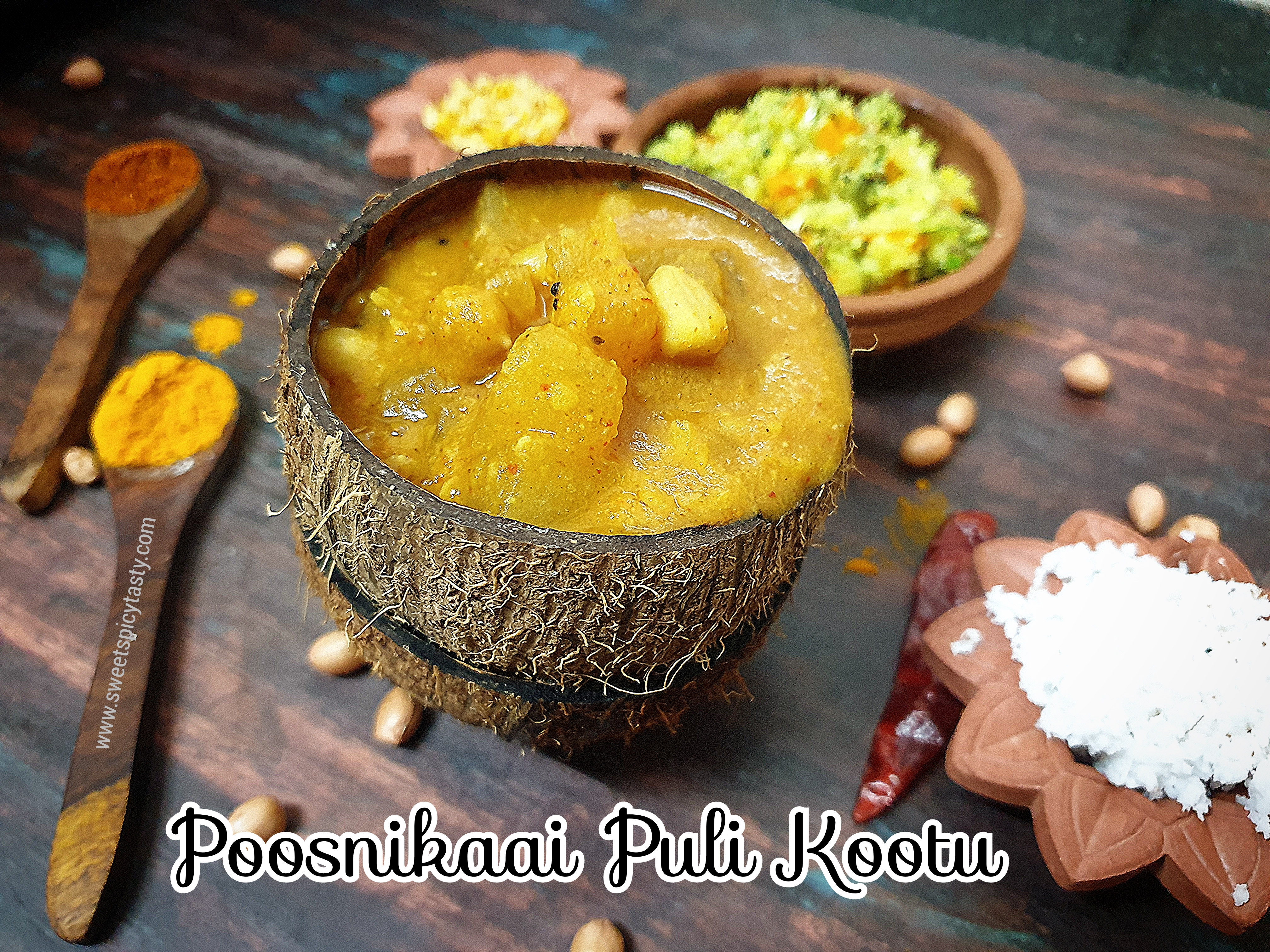
Poosanikaai Puli Kootu - Kalyana Kootu


Share with friends and family 3 comments:

 Puli Kootu or Pulippu Kootu is an authentic Tamil brahmin recipe and is made quite frequently in most homes .It is a must have on the wedding feast menu and hence also known as Kalyana Kootu . 

Puli kootu is very tasty as it has a balance of all flavors and the tanginess from the tamarind extract gives it an altogether different flavor profile.

Pulippu kootu fits perfectly for those following a Vegan Diet and also being a No onion No garlic recipe  it is Saatvik and Jain Friendly as well.

Pulippu kootu can be made with brinjals,  ash gourd /white pumpkin or chayote/chou chou . In traditional tambrahm weddings puli kootu is made from ash gourd/poosanikaai and has either boiled chick peas or groundnuts added to the kootu .

In my recipe today ,I am going to use boiled peanuts but I also make it using boiled chickpeas many a times and both of them taste really delicious. 

Puli kootu with hot rice and some coconut based vegetable stir fry is an amazing combination for lunch.  In my home most often the left over puli kootu is paired with chapati for night and it pairs well .


Preparation Time - 15 mins
Cooking Time - 30 mins
Complexity- simple 
Serves - 2 to 3

Ingredients 

2 cups chopped ash gourd /poosanikaai 
1/4 cup thoor dal /pigeon peas/thuvaram paruppu
1/4 cup peanuts 
Small lemon sized tamarind ball
Few curry leaves 
Pinch of turmeric
Salt as needed 
2 tsp oil 
1/2 tsp mustard seeds
Pinch of asafoetida 

To roast and grind
1 tbsp channa dal 
1 tbsp dhaniya/corriander seeds
2 tbsp coconut grated 
3 to 4 dry red chillies 

Method


  • In a pan heat 1/4 tsp oil and roast the channa dhall until crisp and golden brown followed by the dhaniya and red chillies.Allow it to cool and the  grind into a fine paste with coconut and set aside. 
  • Soak the tamarind in hot water for 10  mins and then extract the pulp . Strain the impurities and keep ready .
  • Boil the chopped ash gourd in sufficient water until it is cooked well..it has to be firm but well cooked .
  • Pressure cook the thoor dhall and peanuts in 2 separate containers in the same cooker .Mash the thoor dhall well and set aside.  This saves a lot of time and effort as well.
  • In a thick bottomed vessel,add the boiled ashgoured ,peanuts and the tamarind extract with 1/4 cup water and boil it until the raw smell of the tamarind is lost. 
  • Next add the coconut paste , cooked thoor dhall and another 1/2 cup water and bring to a rolling boil.Adjust salt at this stage . Donot boil too much as the dhall will begin to start sticking to the bottom of the pan and it may get burnt..we don't want a burnt kootu .
  • Prepare a tempering of mustard seeds, curry leaves and asafoetida and pour it on the pulippu kootu.

Pin it up for future 


September 25, 2022

Little Millet Poha - Samai Poha (Vegan breakfast)


Share with friends and family 7 comments:

 Millets are a very good alternative to rice due to their low glycemic index (GI) value which helps in control of insulin and absorption of carbohydrates into the blood stream making it ideal for people with Diabetes.  

Millets also help in weight loss as they are rich in proteins and fibre.

There are lot of millets available like Jowar, Bajra, Ragi ,Little millet, Kodo millet , Barnyard Millet etc . You can very conveniently replace the usage of rice with millet and work towards a healthy lifestyle. 

I am slowly trying to transition into using millets in my daily diet and I am certainly seeing a lot of difference.  Sudden hunger pangs,  mid morning cravings have reduced a lot and millets keep me full for a long time. 

Little Millet is known as Samo Chawal/Kutki  (Hindi), Samai Arisi (Tamil),  Saame (Kannada) , Samaalu (Telugu) .

Little millet is very rich in Magnesium,  Vit B components and also in phosphorous and zinc which help in building energy in the body. 

Making little millet poha is very easy, almost same as making the Poha using Flattened rice.  You can flavor and season it with the spices of your choice.  

Little millet flakes are available in most leading super markets and shops .Also there are many exclusive outlets selling millet based products from where we can procure them easily . 


Preparation Time - 10 mins
Cooking Time - 10 mins
Complexity - easy
Serves - 2 to 3

Ingredients 

1.5 cups little millet poha /flakes 
2 tbsp oil
Handful of peanuts 
Handful of frozen peas (thawed )
1tsp cumin /jeera
2 green chillies chopped 
Few curry leaves 
Salt as needed 
2 tsp lemon  juice
Pinch of turmeric 

Method 


  • Wash the little millet flakes under running water and let it rest in a colander for 10 15 mins . The millet flakes absorb the water and turn soft. 
  • Heat the oil in a kadai, fry the peanuts followed by cumin ,green chillies, curry leaves.
  • Throw in some salt and turmeric followed by the soaked little millet flakes and also the green peas .
  • Toss it well ,cover and cook for 3 to 4 mins . Lastly mix the lemon juice and garnish with fresh corriander and serve hot.

Pin it up


September 22, 2022

Navaratri Special - Significance & Prasadams


Share with friends and family 7 comments:

 Navaratri is just round the corner and it is a very special festival for Hindus.  The whole of India celebrates Navratri in different ways and it is the most awaited festival for the ladies.

Navaratri is a festival that  celebrates the victory of good over evil by Goddess Durga . The festival is spread across 9 nights and 10 days hence the name Nav Ratri (Nav is 9 and Ratri is night) .

The last day is celebrated as Dussehra or Dassera, a  day that is considered very auspicious to start anything new . 

As I already said each region in India celebrates Navaratri in different ways and the ladies thoroughly enjoy this festival .

Read the full blog to know how various regions celebrate Navratri across our country.

In Northern India , each day is dedicated to 9 forms of Maa Durga  ; Shailaputri  ,Brahmacharini ,Chandraghanta ,Kushmanda ,Skandamaata , Katyayani  ,Kaalaratri, Mahagauri,Siddhadhatri. 

Devi is worshipped  by chanting Chandi Paath/ Havan ,devi Mahatmyam etc. Most ladies fast for the 9 days and break their fast on Navami .

The Ashtami Day is  celebrated as Kanya Puja where young girls who haven't attained Puberty are called home and worshipped as an Incarnation of lord Durga ma and offered with Prasadam and small gifts like Bindi , chunri , mehendi etc. Prasad on Ashtami is Poori ,Halwa and Kala Channa .

In Gujarat , a decorated earthen pot called Garba is placed with a lamp lit inside which is kept as Akhand Diya for all 9 days ..this Garba is symbolic of the womb and the word is derived from the Sanskrit word "Garbh". There is a  belief that just as the mother protects the baby in the womb, Ambe Maa is the protector of the world and she protects us from the wordly  wrath. 

Bengal and Eastern India is known for its Durga Puja Utsav during Navratri and the massive pandals that are set up all over the city which have huge and beautiful idols of Durga Maa sculpted to perfection and on the day of Dassera after the Pooja ,the idols are immersed in water bodies .


In Tamil Nadu and Karnataka ladies set up Golu ,which is a display of dolls of various Gods and Goddesses and also other mythological characters.  Social themes are also displayed and lot of contests are conducted to applaud and recognize the hard work .  The 9 nights of Navratri are dedicated for Durga ,Lakshmi and Saraswati . The 9th Day is celebrated as Saraswati Pooja / Ayudha Pooja in Tamil Nadu ..to know more about how it is celebrated, read my post on Saraswati Pooja Special.

What is Golu / Bomma Kolu / Bombe Habba ?

GOLU is a display of Dolls arranged on steps like structure which are odd in number like 1 , 3, 5 , 7 , 9 steps etc .

Traditionally beautifully colored clay dolls of various Gods and Goddess & Mythological story related dolls would be on the display and these dolls are handed down from generations.  Carefully packed and stored for use year on year. 

 Slowly, with social awareness and creativity,  dolls with social themes also got added to the collection and people who display golu started presenting various themes to bring related to current affairs and social responsibilities. 


Each day a special prasadam is offered to Devi after pooja in the morning and evening. 
Normally in the morning, we offer some kind of sweet as prasadam and in the evening we offer sundal prasadam. Navaratri and Sundal go hand in hand .

Sundal is a simple stir fry using various beans and legumes . A very good source of protein and energy. 


This sundal prasadam is distributed along with the Haldi Kumkum Thamboolam which is given to all the ladies who visit the house for Golu . 

What is thamboolam ?

Thamboolam is an offering of betel leaves, betel nuts, coconut a fruit and haldi kumkum .

Refer to the collection of recipes below which I am linking for your easy reference 


Verkadalai Sundal / Peanut Sundal

Kondakadalai Sundal/Chickpeas Sundal

Karamani Sundal / Lobia Sundal

Karuppu Kondakadalai Sundal / Brown Chickpeas sundal

Thengai Mangai Pattani Sundal / Dried peas sundal

Rajma Sundal 

Kadalai Paruppu Sundal / Gram Dhal Sundal

Kadhamba Sundal / Mixed Sundal

Pacha payaru Sundal / Green Gram Sundal

Sundal using Sundal Podi

Traditional sweets offered as prasadam for Navaratri 


Seeyam / Sugiyan (Saraswati Pooja Spl )