Showing posts with label Mahalaya/Amavasai Thaligai. Show all posts

February 13, 2025

Pudanlangai Thayir Pachadi | Potlakaya Perugu pachadi | Snake Gourd raita


Share with friends and family 8 comments:

Snake gourd /padwal(Marathi)/Potlakaaya (Telugu) /Padavalanga (Malayalam) / Padavalkkai (Kannada) .
Call it by any name it has a lot of nutritional value and is a powerhouse of nutrients. Snake gourd belongs to the summer squash family, mostly a summer produce ,it is available all round the year in India.

Rich in dietary fiber , vitamins A and C ,snake gourds help in digestion ,prevent bloating and constipation . Helps in detoxification of the body because of its diuretic properties. Due to water content present in the snake gourd it helps maintain body's hydration.

Snake gourd /padwal(Marathi)/Potlakaaya (Telugu) /Padavalanga (Malayalam) / Padavalkkai (Kannada) , Snake gourd /padwal(Marathi)/Potlakaaya (Telugu) /Padavalanga (Malayalam) / Padavalkkai (Kannada)  pachadi, perugu pachadi, pachadi, kichadi, padavalnga kichadi, podalanga pachadi, podalanga thayir pachadi, potlakaya perugu,potlakaya, padwal raita, padval raita, dahi padwal

 Podalangai Thayir pachadi is a new addition to my kitchen and hence it is making it to the blog . 
Amma would make it frequently during summer, but over the years I had totally forgotten about this recipe . As a flash,this recipe occurred to me this morning when I was contemplating what to make with fresh and tender snake gourd that I had just bought. The snake gourds have to be tender. Overly ripe ones taste bitter and become hard and chewy . So while buying, make sure the snake gourd vine is easy to twist and tender to feel. If you find it hard or it easily cracks ,then don't buy that .

Podalangai thayir pachadi is very easy to make and gets done in no time . A tasty paste is made using fresh coconut, ginger,green chillies and curry leaves which is added to thick whipped yogurt and boiled snake gourd is mixed along with this followed by a tempering of mustard, dry red chillies and asafoetida. 

Podalangai thayir pachadi is also made during Amavasya, pithrupaksha and Shraadh cooking in a typical Tamil Brahmin household . Vishu and Onam Sadhyas also feature padavalanga kichadi as one of the Sadhya menu items.

Snake gourd /padwal(Marathi)/Potlakaaya (Telugu) /Padavalanga (Malayalam) / Padavalkkai (Kannada) , Snake gourd /padwal(Marathi)/Potlakaaya (Telugu) /Padavalanga (Malayalam) / Padavalkkai (Kannada)  pachadi, perugu pachadi, pachadi, kichadi, padavalnga kichadi, podalanga pachadi, podalanga thayir pachadi, potlakaya perugu,potlakaya, padwal raita, padval raita, dahi padwal

Officially, though it is still winter/spring in India , we are already feeling the warmth in my part of the city. There is hardly any chillness felt and the afternoon sun is at its peak .

As always, with summer setting in; buttermilk,lassi,raita and yogurt based curries make a lot of appearance in my kitchen . Yogurt based curries are light on stomach and easy to digest as well .Most importantly it keeps the body cool during harsh summer and it maintains hydration. 

Snake gourd /padwal(Marathi)/Potlakaaya (Telugu) /Padavalanga (Malayalam) / Padavalkkai (Kannada) , Snake gourd /padwal(Marathi)/Potlakaaya (Telugu) /Padavalanga (Malayalam) / Padavalkkai (Kannada)  pachadi, perugu pachadi, pachadi, kichadi, padavalnga kichadi, podalanga pachadi, podalanga thayir pachadi, potlakaya perugu,potlakaya, padwal raita, padval raita, dahi padwal

Some lipsmacking raitas in South Indian flavor 


Pinterest link


Snake gourd /padwal(Marathi)/Potlakaaya (Telugu) /Padavalanga (Malayalam) / Padavalkkai (Kannada) , Snake gourd /padwal(Marathi)/Potlakaaya (Telugu) /Padavalanga (Malayalam) / Padavalkkai (Kannada)  pachadi, perugu pachadi, pachadi, kichadi, padavalnga kichadi, podalanga pachadi, podalanga thayir pachadi, potlakaya perugu,potlakaya, padwal raita, padval raita, dahi padwal

Preparation Time - 5 mins
Cooking Time - 8 mins
Serves - 2 to 3 
Complexity - easy 

Ingredients 

1 medium vine snake gourd 
1.5 cups thick yogurt
2 tbsp coconut grated
1 green chilli (optional)
2 to 3 dried red chilli
Few curry leaves  
Small piece ginger 
Salt as needed 
1/2 tsp oil 
1/4 tsp mustard seeds 
1/4 tsp udad dhal /black gram 
Pinch of asafoetida 

Note - if you family tradition doesn't use green chilli for shraadh/Amavasya then replace with dry red chillies.

Method 

  • Wash the snake gourd and slit it vertically . Deseed /remove the seeds and chop it into small cubes. 
  • Boil half cup water with salt and cook the snake gourd until soft and tender . Drain the water .
  • Grind the coconut, green or red chilli ,curry leaves,ginger to a fine paste .
  • Beat the curd/yogurt to make it lump free and smooth.
  • Mix the ground coconut paste ,whipped curd and boiled snake gourd . Adjust salt if needed.
  • Prepare a tempering of mustard seeds , curry leaves ,udad dhall, red chilli,asafoetida and pour it over the raita and mix well. 


February 08, 2025

Avarakkai Kootu | Broad beans lentil curry


Share with friends and family 15 comments:

 Avarakkai kootu is a popular side dish from the Tambrahm cuisine made from just moong dhall (yellow split gram) , fresh coconut paste and a Sizzling tempering of mustard seeds ,curry leaves in coconut oil.

Avarakkai(tamil),Avrekkai(Kannada), chikkidkaay (Telugu) is a native Indian vegetable and used extensively across cuisines in India . In the Maharashtra and Gujarat it is called as Vaal papdi or papdi and Sem in Hindi .

Avrakkai is a diabetic friendly vegetable and also rich in protein, dietary fibre,vitamin A ,potassium and folates. Consuming avarekkai is a good source of plant protein and apt for vegetarians to meet their dietary requirements of protein intake. The fibre present in the Indian flat broad beans helps to manage cholesterol in the body.

Since, Avarekkai is a native vegetable, it is used during the Mahalaya Paksha , Amavasya cooking and also for cooking during Shraadh or Devasam. During Shraadh , Amavasai or Mahalaya paksha avrekkai is mostly used in the form of kootu but some families also make a simple stir fry known as Thenga pota curry . 

I shall share the recipe of the simple yet flavorful curry very soon. You may refer to Mildly Indian Seema's Kothavarangai Poriyal and in the same way you can make avarekkai poriyal .

Amavasya Lunch Menu

Avrekkai kootu can be mixed with rice or can also be served as an accompaniment to sambar ,vethakuzhambu, milagu kuzhambu along with some toasted papads and a simple paruppu Thogayal or pudina Thogayal. 

If making kootu to mix with rice, make it a little runny else we can have a thicker consistency. 

Avrakkai kootu is purely Saatvik and Vegan making it No Onion No garlic and Jain friendly .


You may also want to try some lip smacking healthy and delicious kootu recipes from my blog

Chou chou (Chayote) kadalai paruppu Kootu 

Cabbage Kootu 

Thiruvadhirai Kootu 

Poosanikkai (Ashgourd) Pulippu Kootu 

Vellarikaai(Cucumber) Kootu 

Keerai (Spinach) Kootu


Pin it up

https://pin.it/627Wo5jJs


Preparation Time - 10 mins
Cooking Time - 25mins 
Complexity - Simple
Serves - 2 to 3

Ingredients 

150 gms Indian broad beans /avarekkai 
1 cup moong dhall
1/2 cup fresh grated coconut 
1 tsp jeera/cumin
8 to 10 pepper corns
2 dried red chillies 
Few curry leaves 
Pinch of turmeric 
Salt as needed 
1 tsp coconut oil
1/2 tsp mustard seeds 
Pinch of asafoetida 

Method 

  • Wash the broad beans and trim the head and tail. Bundle them up and chop into medium cuts.
  • Wash the moong dhall under running water 3 to 4 times.
  • Add the washed moong dhall,chopped avrakkai ,turmeric , 2 cups water and pressure cook for 3 whistles. Let the pressure release naturally. 
  • Grind the coconut, cumin,red chillies ,pepper with water to a fine paste .
  • Once ,the pressure cools down,lightly mash and mix the lentil and add the ground coconut paste to this along with required amount of salt. 
  • If too thick,add 1/4 cup water and bring it to a quick boil with occasional stirring. Coconut paste has a tendency to stick to the bottom and the kootu will get burnt. 
  • Turn off the stove when the kootu thickens and the raw flavor from the coconut paste is gone.
  • Prepare a tempering of mustard seeds,fresh curry leaves,asafoetida in hot coconut oil and pour it over the delicious kootu.
  • Averakkai kootu is now ready to be served.


October 05, 2021

Basic Mahalaya Amavasai Thaligai ( Samayal) & Vazhakkai Podimaas


Share with friends and family 3 comments:

 Pitru Paksha / Mahalaya Paksha is in veneration of our deceased ancestors.  In my earlier post of Payatham Paruppu Payasam, I have given an elaborate explanation regarding Pitru Paksha.

Pitru Paksha starts on a Pournami /Full Moon Day and Culminates on Amavasya / New Moon Day. This New moon day is known as Mahalaya Amavasya or Sarva Pitru Amavasya ; considered to be very auspicious as it is believed that even if we are unable to pay obeisance to our deceased fore fathers all round the year, offering our oblation on this particular day will please their souls and we shall be blessed abundantly.  

Vazhakkai Kariamudhu / Vazhakkai 
  / Vazhakkai Curry,amavasai thaligai,amavasai samayal,sarva pitru amavasya, tambrahm amavasai samayal, iyengar thaligai , mahalaya thaligai , Mahalaya amavasay samayal

This year Mahalaya Amavasya is on 6th October 2021 . Another speciality of Mahalaya Amavasya is that the Holy Festival of Navratri commences from the day after Amavasya . 

Each family has a different way of offering bhog to the ancestors depending on the family tradition and culture . 

In this post,I am going to share on how Mahalaya Bhog is prepared and offered in a Tamil Brahmin Family . There may be slight variations, but the basic menu remains the same . Almost every Amavasya ,this kind of meal is prepared in homes where elders follow the traditional practice even to this day . So we can call this a basic and simple Amavasya lunch menu .

This is the simplest bhog /samayal /thaligai one can prepare and offer to the ancestors.  You can follow this menu for all the Amavasai / New Moons that fall round the year if you have elders at home who offer Shraadh / Tharpanam on Amavasya. 

Click on the individual recipe names to follow the recipe. 


Unlike regular days ,we cannot use all vegetables and lentils for preparing an Amavasya meal . There are specifications to be followed  . Now a days it is not possible to sit and make such an elaborate spread on working days,so we can follow as much as we can to keep up our traditions rather than give up completely. 

  • Bittergourd (Pavakkai) & Vazhakkai ( Raw Banana) atleast must be included . Other vegetables that can be included are cucumber,  yam, sweet potato (sakkaraivelli kizhangu) , clustered beans(kothavarangai),  flat beans (avarakkai), taro root(arbi /seppankizhangu)
  • Moong Dhall /Payatham Paruppu and Udad dhall /Ulutham Paruppu are the only lentils that are used . 
  • Jaggery to be used for sweetening the paysam. 
  • Coconuts ,dry red chilli, green chillies ,pepper ,mustard ,ginger are to be used for seasoning and as spice agents .
  • Ghee / Nei to be served alongside rice without fail.

Vazhakkai Kariamudhu / Vazhakkai Podimaas / Vazhakkai Curry,amavasai thaligai,amavasai samayal,sarva pitru amavasya, tambrahm amavasai samayal, iyengar thaligai , mahalaya thaligai , Mahalaya amavasay samayal

In this basic Amavasya platter ,I have prepared a very simple and easy menu option which can be prepared without much stress and strain .

The 2 main mandatory vegetables bitter gourd and raw banana are part of the lunch menu.

Click on the individual recipe names to follow the recipe. 


Vazhakkai Kariamudhu / Vazhakkai Podimaas / Vazhakkai Curry 

Vazhakkai Kariamudhu / Vazhakkai Podimaas / Vazhakkai Curry,amavasai thaligai,amavasai samayal,sarva pitru amavasya, tambrahm amavasai samayal, iyengar thaligai , mahalaya thaligai , Mahalaya amavasay samayal


Preparation Time - 15 mins
Cooking Time - 8 to 10 mins
Complexity - easy
Serves - 2 to 3

Ingredients 

3 medium sized raw banana / kaccha kela / vazhakkai 
2 tsp curry powder / kariamudhu podi
Few curry leaves 
2 tbsp fresh grated coconut 
2 dry red chillies 
1 tbsp oil 
1/2 tsp mustard seeds 
Salt as needed 

Method 

  • Peel the raw bananas and roughly chop them into big cubes .
  • Take sufficient water in a pan and boil the chopped raw banana with some salt . The pieces should be well cooked but firm to touch . This may take about 6 to 7 mins.
  • Drain the water and let the bananas cool a bit.
  • In a pan heat the oil and temper the mustard seeds,curry leaves and red chillies. 
  • Add the boiled banana ,saute it well and sprinkle the curry podi over . Toss it well and lightly mash the bananas like how we do for potato curry. 
  • Close a lid and continue to cook for a minute or two . 
  • Finally garnish with fresh coconut and serve .


September 21, 2021

Payatham Paruppu Payasam (Parippu Pradhaman) | Moong dhall kheer - Mahalaya / Amavasaya Special


Share with friends and family 5 comments:

Payatham paruppu payasam is a very simple but tasty kheer or paysam made using moong dhall specially during Amavasya .In my home,this payasam is made only during the days when we offer obeisance to Pithrus.   

This payasam is also known as Parippu Pradhaman made in Kerala for Onam or Vishu Sadhyas . In Kerala style a pinch of cumin powder and dry ginger powder is added to this Pradhaman.

In Hindu Tradition,  Amavasya(New Moon Day) / Amavasai / Amavaas(अमावस्या) is considered very important day to pay obeisance to all the departed souls in the family.  The forefathers are called  as "Pithrus" and the oblation ritual is called "Shraadh/ Tharpanam" . There is a mild difference in the way the shraadh is offered in North and South  India . When I say difference, the difference is in terms of the Prasad offered and also the way the ritual is performed.  In my post ,I will quickly describe the way Tharpanam is done in a typical South Indian Brahmin household .

Black sesame seeds (karuppu ellu ) and water are offered as oblation to the forefathers.  The oblation is offered to Father ,grandfather, great grandfather likewise ,mother,grandmother and great grandmother.  The oblation dates back to 3 generations .  Devout and traditional Brahmins perform this Amavasya Tharapanam every month all round the year .

If one is unable to do it every month ,there is a rule that he must perform the shraadh atleast  on Mahalaya Amavasya, during the Mahalaya Paksha / Pithru Paksha which is a period of 15 days starting from Full Moon to New Moon . This special fortnight falls in the month of September- October and generally corresponds to the Tamil Month of Purataasi.  This year in 2021 Mahalaya Paksham has started on 21 /9/2021. 

Mahalaya Amavasya also known as Sarva Pithru Amavasya will be observed on 06/10/2021.

An elaborate meal which is very satvik in nature (sans Onion and Garlic)  using basic native  vegetables will be prepared and offered to the fore fathers .

Moong Dhall / Split yellow lentils are used while cooking a Shraadh meal and native vegetables like cucumber ,arbi(taro root) , snake gourd (podalangai /padwal) , raw banana (vazhakkai),cluster beans(kothavarangai/gawar) , broad beans (avarekkai/paapdi) , bitter gourd (karela/pavakkai) , ginger ,curry leaves ,coconut are used . Jaggery is used for making sweets and not sugar.  The Amavasya meal is more or less  standard in every household with some minute changes here and there . Jeera/cumin,Pepper and dry red chillies are the only spices which are used .Turmeric is avoided in most homes but some families use fresh root turmeric and not turmeric powder. Mustard seeds and Udad dhall are used for seasoning along with asafoetida.

On other special occasions we prepare different  payasams or kheer . It is customary to prepare Medhu Vada and Moong dhall paysam along with Vazhakkai (Raw Banana) Curry  on every Amavasya even if one is unable to prepare an elaborate spread.


Preparation Time - 20 mins
Cooking Time - 10 mins
Complexity - simple 
Serves - 2 to 3 

Ingredients 
1/2 cup moong dhall/payatham paruppu 
1/2 cup powdered jaggery .
5 to 6 tablespoons grated coconut 
1-2 pods elaichi /cardamom 
1 tsp ghee (skip if vegan) 

**you can increase the quantity of jaggery depending on the level of sweetness you like .

Method 


  • Grind the coconut and cardamom with some water to a fine paste and keep aside .
  • Wash the moong dhall and pressure cook with sufficient water for 3 to 4 whistles or until mushy.  Release the pressure and mash it well with a ladle .
  • In a thick heavy bottomed vessel ,melt the jaggery with 1/2 cup water . If you see any impurities , filter it through the sieve .
  • To this melted jaggery add the coconut paste ,1/2 cup water and cook until the raw flavor of coconut is lost . Keep stirring as the coconut has the tendency to stick to the bottom .
  • Now add the boiled and mashed moong dhall to the above and mix it well . The dhall should blend well with the jaggery coconut decoction. 
  • Continue cooking on medium flame with occasional stirring until it comes to a rolling boil.
  • Turn off the stove and add the ghee ,cumin powder and ginger powder if using  . Delicious paasi paruppu /hessaru bele payasam is ready .
  • You can fry cashewnuts and coconut slivers in ghee and add it to the payasam .
Pin me up


August 16, 2019

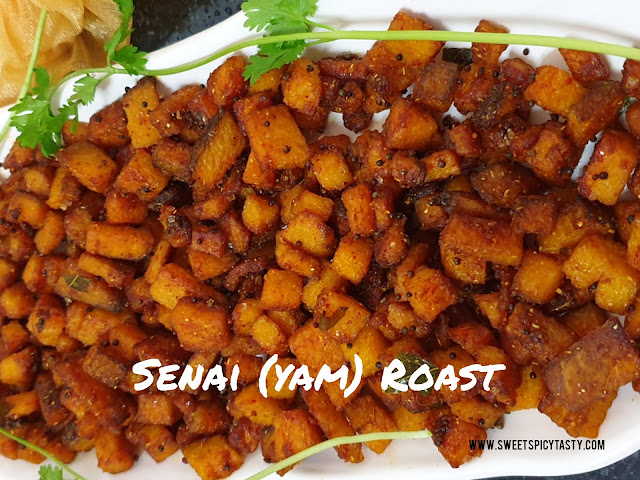
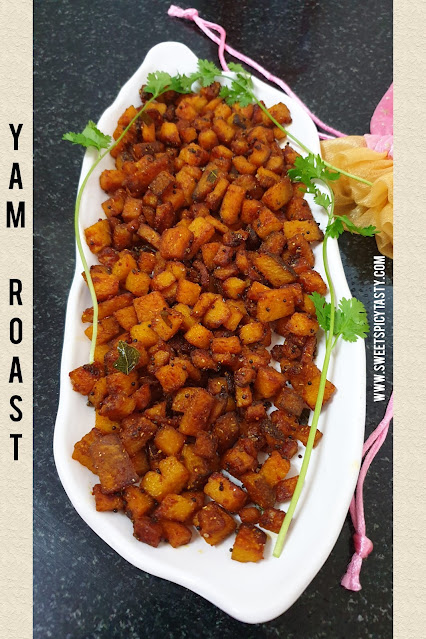
Yam / Suran / Sennaikizhangu Roast Curry


Share with friends and family 11 comments:

Yam / Suran / Sennaikizhangu is probably one of the ugly looking root  vegetables but it is packed with a lot of nutritional value .Yam has a good source of dietary fiber, vit C , vit B6 along with manganese and potassium .  The vegetable is a little difficult to handle as it has a thick skin layer which appears like a  bark of a tree and is generally coated with mud . You need a sharp knife to chop that off and then the vegetable can be cut into slices or diced as per recipe.


Today's recipe is my maternal grandma's signature recipe which was passed on to my mom and then now I have taken to it . Unfortunately I have not tasted the version  made by my grandma , but have eaten the preparation by mom N number of times .  The final product has  a burst of flavors in your mouth due to the spicy and tangy marination used to coat the yam cubes .

Preparation time: 20 mins
Cooking Time : 20 mins
Complexity  : simple


Ingredients
250 gms yam / suran/ sennai
1 tsp red chilli powder
1 tsp rasam powder
1/2 tsp turmeric
2 tablespoon thick tamarind extract
1 tsp jaggery powder
Salt as needed
Asafoetida / hing as needed
1 tablespoon cooking oil
1 tsp mustard seeds
Few curry leaves .

Method

  • Chop the hard skin off the yam and wash it thoroughly. 
  • Grease your palms and cut the yam into small cubes and wash them well . ( greasing with coconut oil prevents itching )
  • Drain the water and in a mixing bowl , add salt , turmeric, rasam powder, chilli powder and the tamarind extract and toss the yam cubes well until these spices coat each cube well . Let it rest for 10 mins. 

  • In a frying pan (preferably nonstick) , heat the oil and splutter the mustard seeds along with curry leaves and asafoetida.  
  • Add this marinated yam cubes in the oil and toss it well . 
  • Sprinkle some water and keep covered for about 8-10 mins . Open the lid occasionally and stir it.  

  • Once it is 3/4th done , add the jaggery powder and toss it again with a spoon of oil and cook until they turn crisp and crunchy. 
  • Turn off the stove and serve hot with rice and sambar or rice and kootu . 

Pin me to your board 


April 21, 2017

Arisi Upma | Broken rice upma | Akkithari Uppit - Video Recipe


Share with friends and family 5 comments:

Arisi upma or Broken rice upma is a very staple breakfast or dinner in most tamil homes. If you have rice rava handy then its a breeze to make this upma as it gets done in less than 15-20 mins.

 Once the upma is ready,allow a standing time of min 20 mins to get the perfect crumbly and grainy texture . We call it Udhur Udhur Upma ,I don't know the exact translation for this in English; as it is a texture to be felt and enjoyed .

Arisi upma is a very filling breakfast and can keep be eaten for brunch as well. Tamil Brahmins have arisi upma on Ekadasi , during Pitru Paksh or even on Amavasya night for dinner when the men folk are not allowed to eat rice at night after performing the Tharpanam .

Akki tharri uppit , arisi upma , kurunai upma , Amavasai thaligai kurunai upma , arisi kurnai upma , arsi kurunai  , rice kurnai , akki thari , akki uppit , arisi kurnai , how to make arisi kurunai at home, broken rice rava , cream of rice , raw rice rava

Having rice rava handy at home,this upma comes to my rescue even as a dinner option when I am pressed for time or run out of options. Serve this upma with coconut chutney,tomato gothsu/ tomato gojju or as is with just a cup of plain curds it tastes heavenly.

I am including the method of making rice rava at home which I normally follow. There are different ways in which you can make rice rava at home.  

I have included the different methods of making rice rava at home. You may use the regular white rice or even the brown unpolished rice.  Pls donot use any aromatic rice variety like basmati, jeera Samba, jasmine rice etc. 

Jain version : Skip the ginger and follow the recipe as is


   How to make rice rava /akki thari / kurunai at home?


Rice rava is known as Arisi kurunai in Tamil and Akki Tharri in Kannada.  Kurunai and Tharri means coarsely broken bits of any grain (wheat , millets,rice etc) 

Method 1 

  • Pulse the required quantity of   raw rice  in a mixer grinder . The texture should be slightly coarse and granular as compared to the regular upma rava .

Method 2 

  • Wash and drain the required quantity of rice in a colander and leave it for half an hour .
  • The water will drain completely and the rice would have soaked well . If you touch the rice with your palm it shouldn't be wet and must easily fall off your palm when you shake . This means the rice is well soaked and ready to be pulsed in the blender .
  • Add it to the blender and pulse until you get a coarse and grainy texture .

Method 3 

(Updated in Oct 2024)
  • Soak  and drain the rice as in Method 2.
  • For 1 cup of rice, dry roast 2 tsp thoor dhall, 3 to 4 dry red chillies ,1tsp pepper ,1tsp jeera and curry leaves until the dhall turns golden brown. Let this cool.
  • Pulse this roasted ingredients along with the drained and soaked rice till you get the coarse rava texture.  
(This 3rd method of making rice rava ,I recently learnt through a reel on Instagram and I must say the taste of arisi upma was too good . The color wasn't pure white like how arisi upma normally looks,but taste was outstanding)

Akki tharri uppit , arisi upma , kurunai upma , Amavasai thaligai kurunai upma , arisi kurnai upma , arsi kurunai  , rice kurnai , akki thari , akki uppit , arisi kurnai , how to make arisi kurunai at home, broken rice rava , cream of rice , raw rice rava

Now ,let us see how to make arisi upma using home made rice rava . The entire post has undergone a cosmetic change in terms of adding clear and better pictures along with some tips and tricks to get a perfect Arisi upma .  Hope all my readers find it useful. 

Preparation Time - 20 mins
Cooking Time - 15 mins
Standing Time - 15-20 mins
Complexity - medium 

Ingredients
1 cup rice rava
3 cups water 
2 green chillies finely chopped 
2 dry red chillies 
(skip if your rice rava already has red chillies) 
1 tsp finely chopped ginger
Handful of curry leaves 
2 to 3 tbsp coconut oil / regular cooking oil 
1 tsp mustard seeds 
1 tsp udad dhall
1 tsp channa dhall
1/4 cup fresh grated coconut 

Method 

Prerequisite

Using thick bottom pan is very important as we will be doing slow cooking and don't want the upma to get burnt . Pressure cooker vessel is ideal for making this upma or a huge bronze pot(vengala paanai) 

** I have used rice rava made using method 3 for making arisi upma in the pictures that you are seeing on the post now. 
  • Heat oil in the pan and crackle the mustard seeds , channa dhall and udad dhall till it turns brown.
  • Fry the green chillies , curry leaves,  ginger along with asafoetida. 
  • Add in the 3 cups of water will required about of salt and let it come to a rolling boil. 
  • Carefully add the rice rava and keep stirring constantly to avoid lumps . (Or)
  • Roast the rice rava lightly and add 3 cups of boiling water and salt into the pan ,this will prevent lumps.
  • Add the grated coconut, mix everything well ,reduce the flame to low ,close with a lid and continue cooking on low flame for 10 mins.
  • Open after 10 mins ,give it a good mix ,close again and cook for another 5 mins on low.  
  • You can see that the rice rava has absorbed all the water and the upma looks fluffy and well done .
  • Turn off the stove and let it sit for 10 mins before serving.
  • You can add some ghee on top while serving.
  • I paired the arisi upma with milagu kuzhambu from lunch ,coconut chutney and thick home made curd.  You can also pair it with tomato gojju or just plain curd .

(Check the video link above to get  a first hand demonstration of making arisi upma and do subscribe to my channel if you feel like  )


February 07, 2017

Inji Karvepillai Thogayal | Ginger Curryleaves Chutney (Relish)


Share with friends and family 8 comments:

Ginger as well as curryleaves are widely used in many forms in the Indian Kitchens and South Indian kitchens are no exception. No meal is complete without the addition of these two in any recipe. 

Inji Karvepillai thogayal is very commonly prepared in most tambrahm homes atleast once a week . Normally the thogayals are paired with a simple maincourse like Morkuzhambu or vetha kuzhambu and some roasted papads and a simple coconut based vegetable stir fry

Inji Karvepillai thogayal is also prepared during Amavasya and Dwadasi Cooking . 


As curry leaves and ginger are very beneficial for proper digestion ,overall health and immunity normally we make it when there is a lavish spread like festivals or functions.  I enjoy this Karvepillai thogayal with chilled curd rice.  It is so very satisfying to end the meal with a refreshing after taste lingering around the taste buds .

In addition to mixing it with hot rice and ghee as part of the main course meal, you can also enjoy the thogayal with chapati,dosas and puris as well


Preparation Time : 5-10 mins
Cooking Time : 5 mins
Complexity : simple
Serves : 2-3 people

Ingredients

handful of curry leaves ( 2 -3 sprigs /20-30 leaves) - wash and pat dry with a kitchen towel.
1 inch piece of ginger (peel the skin)
2-3 tbsp grated coconut
4-5 tsp udad dhall
1 tsp pepper corns
3-4 dry red chillies
small piece of tamarind
1/2 tsp asafoetida/hing
100ml water for grinding.
salt to taste

Method

©Sweet Spicy Tasty©
  • In a small kadai/pan,heat oil and roast the udad dhall till you get a nice aroma and the dal starts turning a little brown.
  • Add the pepper corns and curry leaves at this stage and roast well.
  • Add the red chillies and roast for a minute or so .
  • Next add the asafoetida,tamarind  and turn off the heat. Let it cool for a few mins.
  • Add all the roasted ingredients along with the coconut,salt and chopped ginger ,100ml water and grind it coarsely and not very smooth like chutney.
  • Adjust the water if you find it difficult to grind.
  • Thuvayal/Thogayal as such is a little thick in consistency but if you want it to be a little loose/runny you can add some warm water and adjust the consistency. Donot add too much water as the flavor and texture of the thogayal will be reduced when diluted.

Pin it up 


This post was first published in 2017 and I recently  updated this post in August 2022 with fresh photos and write up linking to various other recipes.  Thanks to Renu for forming the Facebook group redoing old posts which is a very nice initiative to revive and activate old posts.