Showing posts with label Festival Special-Narsimha Jayanti. Show all posts

March 28, 2017

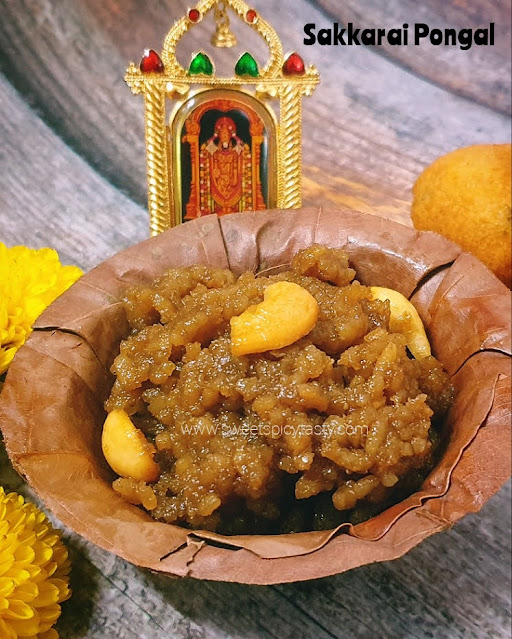
Sakkarai Pongal | Chakkarai Pongal ( Jaggery Rice Pudding)


Share with friends and family 6 comments:

Sakkarai Pongal is a very common neivedhiyam offered to the lord and served as Prasad to the devotees. This Sakkarai Pongal is slightly different from the Pongal we make during Makara Sankranthi / Pongal Pandigai .

Sakkarai in Tamil means Sugar but contradictory to the name ,the recipe doesn't use sugar at all . The Pongal is made using jaggery .

Sakkarai pongal,step by step details how to make sakkarai pongal,chakkarai pongal easy method,prasadam for navratri-sakkara pongal,ramanavami prasadam,bhog for

Here ,in this recipe , the main ingredients are rice and jaggery while the Pongal that is prepared on the eve of Sankranti is made using Rice,Moong Dhall,milk and jaggery where in the rice and dhall are cooked in milk until they are soft and mushy. Compared to the long drawn process ,this is very quick and easy to make.

Chaitra Navratri,Ugadi,RamNavami,Tamil New Year ,Vishu - with all these festivals lined up in the next 10 -15 days prepare this delicious mouth watering Sakkarai Pongal and treat yourself as well as your family.

Sakkarai Pongal is also made as an offering during Navaratri , Aadi Velli,  Aadi Sevvai  (Aashada Friday and Tuesday) and most importantly during Purataasi Month (corresponds to Gregorian Months of September- October ) on Saturdays as an offering to Lord Balaji along with Ellu Saadham (Sesame Rice) or Puliyogare  (Tamarind Rice)

Sakkarai pongal,step by step details how to make sakkarai pongal,chakkarai pongal easy method,prasadam for navratri-sakkara pongal,ramanavami prasadam,bhog for

The color of the sakkarai Pongal will depend on the kind of jaggery that is being used.  I normally use organic jaggery ,hence the color is deep brown . If you use the normal jaggery which is golden in color,the Sakkara Pongal would also have a golden color. 

Use of edible camphor /pacchhai karpooram is optional ,but I highly recommend using it as it gives a very nice taste and also a refreshing after taste lingering in your taste buds.


Preparation Time : 15- 20 mins
Cooking Time : 10 mins
Serves : 2-3
Complexity : medium

Ingredients
1/2 cup rice  ( approx 100 gms)
1/2 - 3/4 cup powdered jaggery .
2-3 cardamoms powdered
pinch of edible camphor / pachhai karpooram
2 tablespoon mix of cashews and raisins
2 tablespoon ghee

Method
  • Pressure cook the rice with water in the ratio of 1 rice : 3.5 water. 
  • Mash the rice well with the back of a spoon until its all mushy . You can add about 1-2 teaspoons of ghee while mashing . It gives a distinct aroma to the rice. Mashing is the key step to get a very nice gooey texture like the ones we get in temples.
  • Add the powdered jaggery to this mashed rice and mix it well until most of the jaggery melts and mixes well with the rice.  Alternatively you can also melt the jaggery in 1/4 cup water and then mix the mashed rice with it .
    • Note : Incase you feel the jaggery is having some impurities,melt in hot water ,strain it and then add it to the rice and mix it well.
  • In a kadai,heat about a tablespoon of ghee,roast the cashews and raisins and keep it aside.
  • In the same kadai add this cooked rice and cook on medium flame.
  • Incase there were some jaggery lumps ,they will start melting now.Need not worry.
  • Add the elaichi powder,camphor and mix well.
  • After about 2-3 minutes,you can see that the mixture starts oozing ghee from the sides and looks very glossy and attractive.
  • At this stage add one more tablespoon of ghee and mix well till you get a good aroma.
  • Stick a ladle in the middle of the rice and it should stand without falling,this is the right time to take it off the flame.  Check out the detailed video below with all tips and tricks to get the perfect sakkarai Pongal .
  • Add the roasted cashews and raisins,mix well and serve .
Subscribe to my YouTube Channel and donot forget to share it with your friends and family !! 


Pin me up !! 


Updated this post with latest photos,write up and my  yotube video link as part of Redoing Old posts activity of our Facebook group . 

First published in March 2017 and updated today on 18 sept 2022.


March 14, 2017

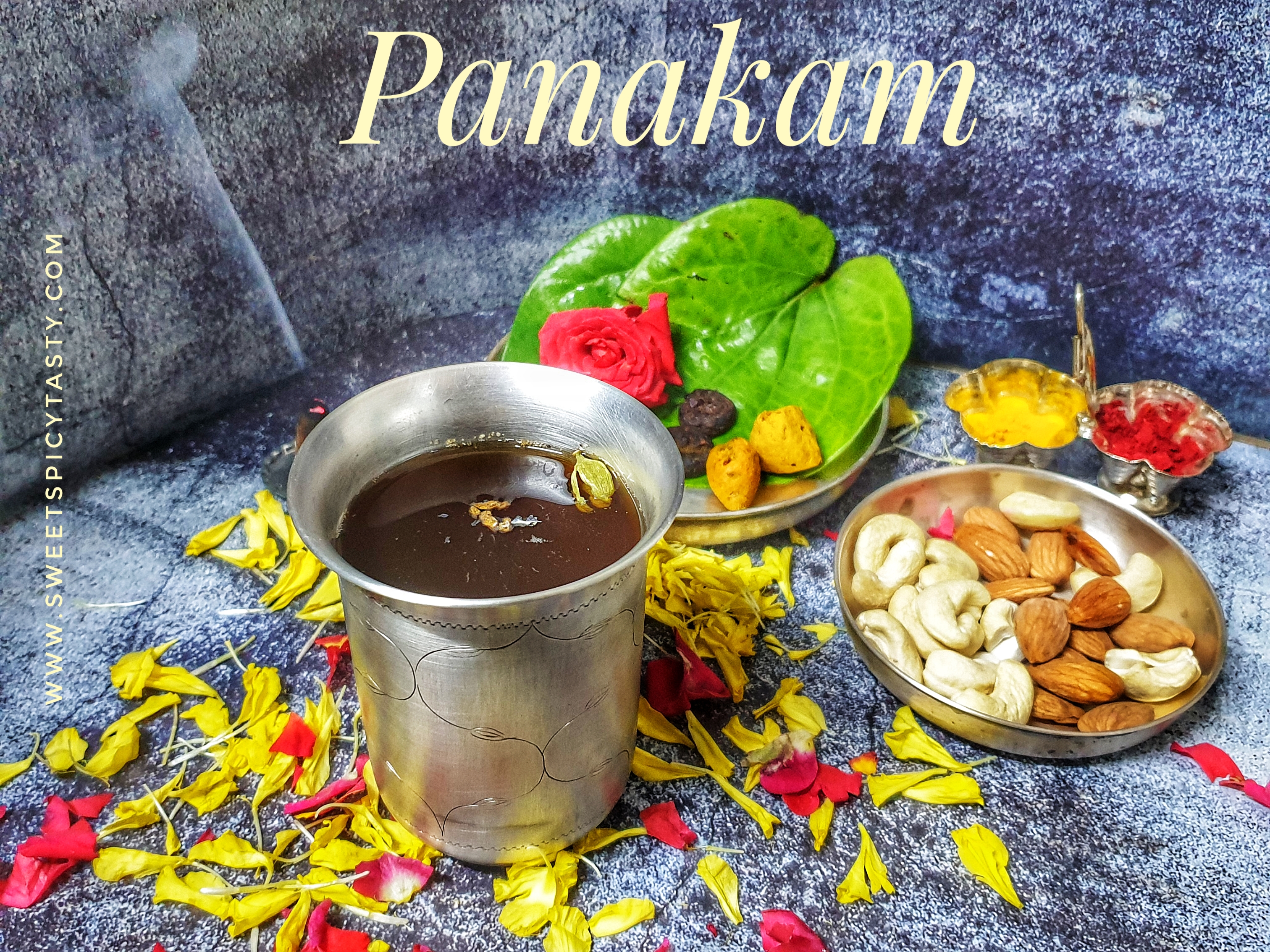
Paanakam| Paanagam - Traditional Indian Cooler (Ramanavami & Narsimha Jayanti special)


Share with friends and family 9 comments:

Paanakam /Panagam is a traditional South Indian summer cooler made using jaggery,ginger powder ,lemon and cardamom powder. Its a power packed energy and health drink to keep the body well hydrated and maintain the body temperature during the severe summer days .
The jaggery version of Paanakam is popular in Tamil Nadu while the lemon based Paanaka is popular in Karnataka . 

(Photos and write up updated on 20th March 2022)


Jaggery is a very good source of iron and potassium while lemon and ginger have antioxidants and good digestive properties. Since summer is the time when the heat wave causes excess dehydration and also leads to increase in body heat, a glass of chilled Panakam on a daily basis will help fight all the dehydration, tiredness and exhaustion .

In  Tamil Nadu,we can find huge stalls along the road side where free Panakam is served to the wiery pedestrians . Even temples have huge pandals or shamianas where panakam and neer mor (spiced Buttermilk) is served to the devotees as prasadam after the Pooja rituals.

Ramanavmi and Narsimha Jayanthy are the two main summer festivals where in Paanakam is a main offering .

Prasadam for both the festivals is incomplete without the Paanakam along with 


Ramanavami 2022 - April 10th

Ramanavmi is celebrated to rejoice the birth of Lord Rama ,the 7th avatar/incarnation of Lord Vishnu . The festival normally falls in the Gregorian Month of March or April every year . As per Indian Calender it is celebrated on the 9th Day of the Chaitra Shukla Paksha (9th day after Amavasya).
Devotees chant verses from Ramayana or sing hymns/bhajans in praise of the Lord and offer prasad and Arati towards the end of the Pooja Rituals.


Narsimha Jayanty is celebrated to rejoice the 4th Incarnation of Lord Vishnu on the 14th day of Vaisakha Shukla Month (14th day after Amavasya); Generally it is in the Gregorian Month of May.
Lord Narasimha incarnated as Half Man and Half Lion to save Prahlada- an ardent devotee of the Lord Vishnu from his Demonic Father Hrinyakashyapu.It is believed that the lord incarnated at the time when the Sun was about to set and the Moon was to rise called as Andhi Sandhi Time .Hence the festival is also celebrated at that time of the day .Devotees observe fast the whole day and immerse in the activities like singing bhajans,doing some kind of charity work and finally break their fast after offering Pooja,Prasad and Arati to the Lord.


This post includes step by step video to make Paanagam / Paanaka


Preparation Time : 5mins
Cooking Time : Nil
Serves  : 2-3 glasses ( 300 ml approx)
Complexity : Simple

Ingredients

1 cup powdered jaggery (160-180 gms)
1.5 cups water (1 cup is 200 ml approx)
1 teaspoon dry ginger powder/chukku podi/shunt powder
2-3 cardamoms/elaichi/elakka powdered
pinch of edible camphor/pacchai karpooram
2-3 teaspoons lime juice
few strands of saffron/kesar/kungumapoo

Method
  • Soak the jaggery in 1.5 cups of water and let the jaggery melt .
  • Stir it well and filter it to remove any form of impurities.
  • Now add the ginger powder,cardamom powder,edible camphor,saffron strands and stir well.
  • Lastly add the lemon juice mix well and serve it chilled or as is.

Pin me up 


April 20, 2013

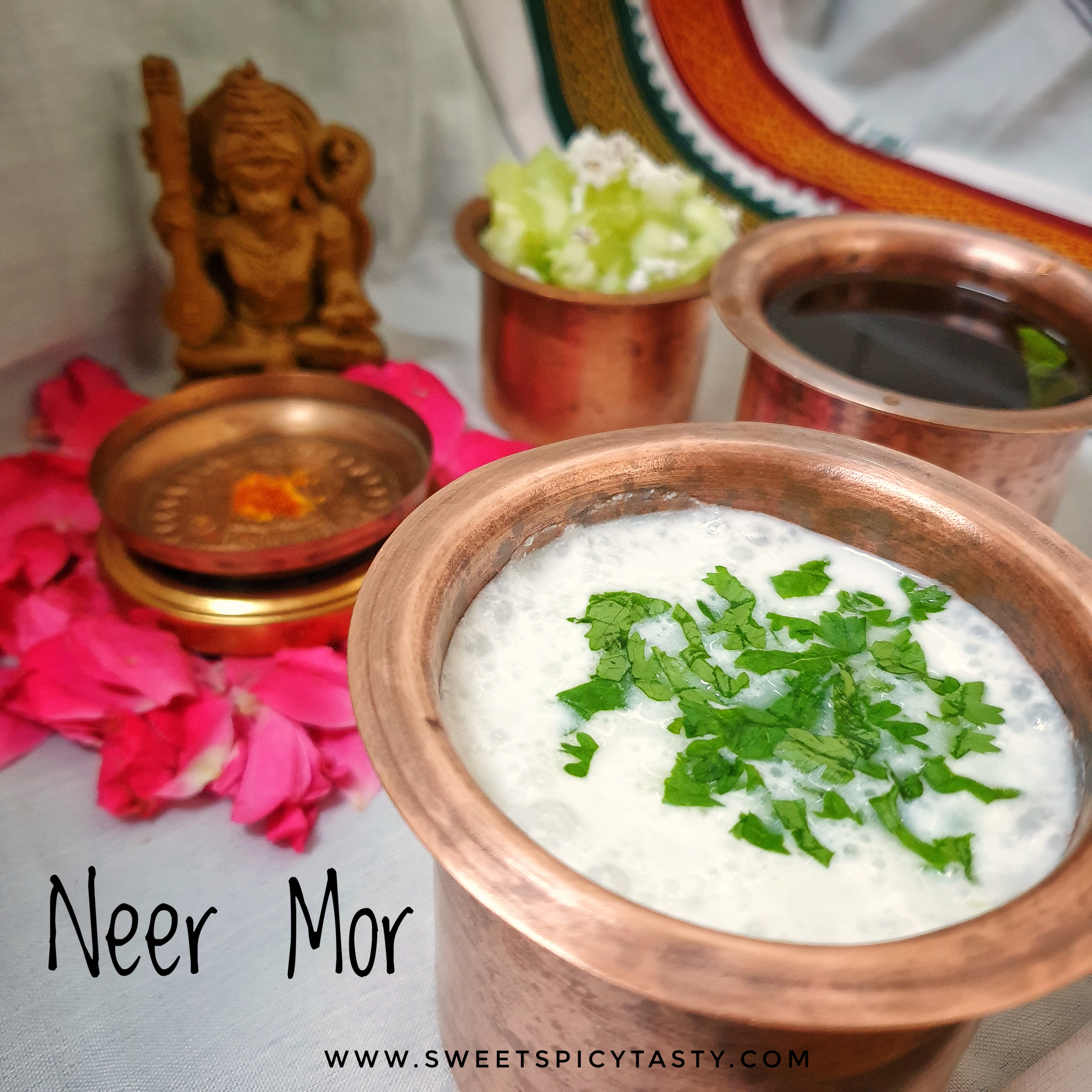
Neer Mor / Neer Majjige (Spiced Butter Milk) - Ramanavmi Prasad


Share with friends and family 7 comments:

Traditionally buttermilk is the residue that is left after churning out the butter/cream from yogurt.
Buttermilk / Mor / Chaas is a favorite summer cooler in most parts of Indian sub continent.

Come summer, we can find stalls along the streets serving cool buttermilk  churned out from huge earthen pots to the weary travelers during the scorching summer months.


Neer Mor (Neer - water ; Mor - Buttermilk) is the South Indian version of  savory butter milk. During summer even temples serve Neer Mor as prasadam to the devotees after the daily veneration and pooja rituals at the temple.
In South India the flavor of curry leaves and ginger will be predominant in the buttermilk while in North India ,roasted cumin powder ,black salt, chat masala etc are used for flavoring the buttermilk.

 In North India  Masala chaas  and Pudina Chaas are the favorite versions of savory buttermilk..Sweetened version of buttermilk is called Lassi and it is slightly dense and creamier than the chaas /mor.


Neer Mor is offered as a Prasadam /Neivedhiyam along with Panakam ,Kosamri (Vada Paruppu) on Rama Navami- Birth of Lord Sri Rama.

(write up and photos updated on April 8th 2022)

Preparation Time : 10 mins
Cooking Time: Nil
Serves : 4

Ingredients

1/2 cup thick curd / non flavored yogurt
1 tsp grated ginger
2-3 green chillies finely chopped
4-5 curry leaves finely chopped
corriander/cilantro leaves chopped
pinch of asafoetida
4 cups water
salt to taste

Method

  • Add the ginger,  green chillies and curry leaves in a blender jar and give it a  quick pulse in your blender to a form a paste.
  • In a big pitcher or wide mixing bowl whisk the yogurt along with the green chilli paste, salt and asafoetida till they mix well.
  • Slowly add the water and using a manual whisk or hand blender, blend it until frothy.
  • Garnish with fresh corriander and serve chilled.
Note:
  • In case,you donot have a hand blender,beat the curd well along with other ingredients except water using a spoon until creamy.
  • Slowly add the water and stir well until all ingredients are well incorporated.
  • Mustard seeds,seasoned in oil can also be added to the buttermilk for added flavor and taste.
You can also try the Omavalli Neer Mor . This is very flavorful and has a unique taste from the ajwain leaves also known as Dodpattre or Karpooravalli . 

Pin me up


April 17, 2013

Southekaai (Vellarikaai) Kosambri / Indian Style Cucumber Salad


Share with friends and family No comments:

Southekaai (Kannada) / Vellarikaai (Tamil) / Khira (Hindi) / Dosekaya (Telugu) / Cucumber is a sought after vegetable used in most Salads or curries which have a lot of vitamins and health benefits.
Fresh green cucumbers may be had as it is without any additions.The yellow cucumber variety also popularly known as Indian Cucumber is widely used in South India in stews,curries and gravies.

As a child ,cucumber has always been a summer special vegetable where in we would have the cool cucumber slices with a little salt and paprika sprinkled over  to beat the afternoon scorching sun.Now that it is summer now,you can include this simple salad in your daily meal.Quick to make and provides the necessary nutrients required .
This salad is a part of any South Indian festive meal especially during Rama Navami,a handful of soaked moong dhall is added to this salad and is offered to Lord Sri Rama as Neivedhiyam / Prasadam. This salad is also called as Vadai Paruppu in most Tamil house holds.


Preparation Time : 10 mins
Cooking Time : Nil
Serves : 3-4

Ingredients

2-3 medium sized green cucumber
2 tbsp grated coconut 
1 tsp pepper powder  
Finely  chopped corriander
salt 
For Tempering
1 tsp mustard seeds
1/2 tsp udad dhall
1/2 tsp channa dhall
pinch of asafoetida 

Method

  • Peel and wash the cucumber. Ensure that,you trim of the ends using knife and rub the ends to bring out the sticky, off-white, fluid like oozing substance. It helps to lessen bitter taste from the cucumber.
  • Cut them into fine small cubes and put it in a mixing bowl.
  • Prepare the tempering using the ingredients listed under Tempering .
  • Add the grated coconut,tempering,pepper powder to the mixing bowl and toss well.
  • Add salt just before serving and not well in advance else the salad will become soggy and the crispness of the cucumber will be lost.
  • Garnish with fresh corriander. 
  • Salad can be served chilled or in room temperature.
Notes :
  • For those who love tangy flavor,a teaspoon of lime juice or small bits of raw mango can be added for that extra taste.


April 16, 2013

Puli Aval / Gojju Avalakki/ Tamarind Poha / Huli Avlakki


Share with friends and family 1 comment:

Puli Aval (Tamil : Puli - Tangy ; Aval - Beaten/Pressed Rice)
OR
GojjuAvalakki (Kannada : Gojju- Tamarind sauce with spices ; Avalakki - Beaten/Pressed Rice)-- popular dish from Karnataka.

 A quick snack which can be made either for breakfast or evening tea time snack .Comes very handy even if you have unannounced guests who drop in suddenly.
 
This is my mom's recipe and I just love this. Since it is my favorite,it used to be a part of lunch box menu during school days. I had quite forgotten about this snack until one day when my mom reminded me of this yummy dish when I was asking her to suggest me a quick sumptuous breakfast.

**Picture updated on Oct 9 2021


Gojju avlakki is also prepared on festive days in Karnataka and Tamil Nadu as an offering for the lord .  Puli aval is prepared during Navratri , Narsimha Jayanthy and  Krishna Janmashtami.

Preparation Time : 10 mins
Cooking Time : 15 mins
Serves : 2-3

Ingredients

1.5 cups thick poha /flattened rice
4-5 tbsp tamarind extract (soak tamarind in warm water and extract the juice)
1 tbsp sambar powder or rasam powder 
1 tsp grated jaggery
salt to taste
pinch of turmeric
For Tempering
1 tsp mustard seeds
1 tsp channa dal
1 tsp udad dhall
handful of peanuts/groundnuts
2-3 dry red chillies
curry leaves - few number
pinch of asafoetida

Method


  • Wash the poha twice well under running water in clean the dust and unwanted particles.
  • To this soaked poha add tamarind water,sambar powder,turmeric,jaggery,salt and mix well with a fork.Rest for about 7-8 mins.Do not mix too much as it will break the poha.
  • If you need a little more spice ,add in some more sambar powder according to your taste
  • In a kadai/skillet,heat a little oil . First fry the groundnuts until the skin separates.
  • Next add the mustard seeds,as it crackles add channa dhall,udad dhall,red chillies ,curry leaves & asafoetida.
  • Add in the marinated poha and mix well and cook covered for about 4-5 mins.
  • Sprinkle some water lightly if the poha feels too dry.
  • Serve hot with some cool curd and roasted papads / potato chips.
Notes:
If you like you may add a little grated coconut just before serving.


Some more Poha varieties on my blog that you may like to try 


Tomato Poha